
Distributor / Manifold
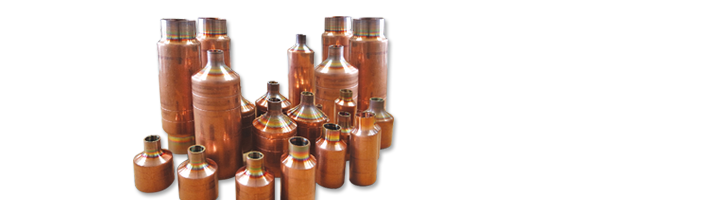
A fluid distributor designed for installation in heating and cooling systems such as residential air conditioners, industrial air conditioners, automobiles, and boilers.

1. Description of the Existing Refrigerant Distributor
Role of the Refrigerant Distributor
The refrigerant distributor evenly distributes the refrigerant — a mixture of liquid and vapor discharged from the expansion valve — to each circuit.
After leaving the expansion valve, the refrigerant exists in a mixed phase of liquid and vapor.
Although the refrigerant is heavier in liquid form by weight, the vapor occupies a much larger volume.
Due to the characteristics of the fluid, the liquid and vapor phases flow in separate layers with different velocities. Under the influence of gravity, the liquid tends to flow along the lower part of the tube, while the vapor flows along the upper part.
If the distribution is not properly balanced, some circuits may receive almost pure liquid refrigerant — absorbing a large amount of heat in the evaporator — whereas other circuits may receive only vapor, which cannot absorb heat effectively. As a result, temperature variations occur across the surface of the evaporator.
To resolve this problem, a pressure drop type distributor with a nozzle orifice was developed. This design ensures that as soon as the liquid and vapor phases are fully mixed, the refrigerant passes through an improved conical section and is evenly distributed to each circuit.
2. Types of Existing Distributors
| Material Types | External Appearance of Each Type of Distributor | Internal Structural Configuration |
|---|---|---|
| Copper tube Distributor/ Manifold | 
 |
 |
| Brass Distributor | 
 |
 |
| Brass Distributor/ Bush | 
 |
 |
3. Description of the New Refrigerant Distributor
3-1. Configuration

[Advantages]
- The product can be manufactured using various selectable material options.
- Compared to the existing product, the new design has reduced volume and length, resulting in more than 30% cost reduction.
- During partial assembly, modular manufacturing processes can be effectively applied.
- The product can be easily applied and produced for residential, large-scale, industrial, commercial vehicle, and boiler models.
- A built-in pressure boosting type can also be developed and manufactured.
- This product is lighter in weight compared to the existing model.
- Automated brazing welding operations are easily applicable.
- After welding, capillary alignment correction is easy, maintaining a straight joint at the welded section.
3-2. Internal Structure of the New Distributor

Distributor
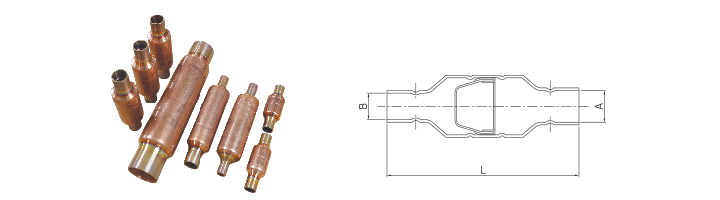
- Equipped with a refrigerant gas inlet pipe and a capillary guide with adjustable depth control.
- Functions as the starting point (conical section) for refrigerant gas distribution.
- Streamlined integration between the body and the distribution guide minimizes cross-sectional resistance in the refrigerant flow.
- The central conical shape and sloped surface ensure uniform distribution of refrigerant to each capillary tube.
- Provides guiding support for capillary tube welding and ensures smooth refrigerant flow.
* The internal structure secures a wider flow passage for the refrigerant gas, reducing noise levels.
* By inserting the distribution guide inside the body, gas leakage and defect rates caused by micro-cracks in the raw material are reduced, while minimizing external exposure of the distributor.
3-3. Features of the New Distributor (Manifold) and Cost Reduction Summary Compared to Existing Products (Based on 3-Port Model)
| Single product photo | Product name | Product specification | Material weight | Welding process | Capillary bending section | Total product length | product photo | |
|---|---|---|---|---|---|---|---|---|
| Existing products | 
| Brass Distributor | Ø20.6 *L34.6 | 100g +30g = 130g | Welding point: 4 points – manual welding, | 2 places | 190mm |  |
| Existing products | 
| Strainer / Brass Distributor | Ø21 *L52 | — | Welding point: 3 points – manual welding, | 2 places | 85mm |  |
| New products |  |
JM distributor / Manifold | Ø18.5 *L34 / Ø18.5 *L52 | 45g +30g = 75g | Welding point: 2 points – automatic welding | 1 places | 52mm |  |
4. Structure, Configuration, and Application Examples of the New Refrigerant Distributor Assembly (ASSY)
4-1. Structure, Configuration, and Application Examples of the New Refrigerant Distributor Assembly (ASSY)
New refrigerant distributor (Manifold) with improved manufacturing cost and quality

By combining the brass distributor, which functions as a distribution and dispensing device, with the strainer, which filters foreign substances contained in the refrigerant, two functions are integrated into a single unit.
Process improvements include the elimination of one silver brazing operation and the removal of connecting piping.(Material and machining costs may vary depending on the diameter size, Φ.)
4-2. Structure and Configuration of the New Refrigerant Distributor (Manifold) Assembly (ASSY)
 |
||
Application of the new refrigerant distributor (Manifold) |
Application of the new refrigerant distributor (Manifold)
|
|
 |
Internal and external performance of the new refrigerant distributor (Distributor / Manifold)
|
|
4-3. Application Example of the New Refrigerant Distributor

4-4. Application Example of the New Refrigerant Distributor

5. Test Report for Patented Distributor Product


6. Quality Improvements of the New Refrigerant Distributor

A Product Performance and Quality Improvement
- By using A, the lifespan and performance of key components such as the condenser and evaporator in air conditioners and heaters can be effectively enhanced during operation.
- When operating the air conditioner, the refrigerant gas circulates and transforms quickly to generate cool air in a short time.
- By using A, during refrigerant gas circulation within the chamber, the conventional copper distributor often causes a vortex phenomenon due to collision with the internal cross-section, resulting in reduced distribution performance and clogging of the filter mesh by foreign substances. However, the A product resolves these issues.
- During the manufacturing and production of air conditioners and heaters, the use of A enables space efficiency, simplified assembly processes, and cost reduction.
- When refrigerant gas flows, after partial assembly, the product reduces and prevents gas leakage defects (such as cracks in the distributor section).
- By applying a completely different distribution mechanism from conventional distributors, it significantly reduces minor noise during gas flow.
- The A product can be easily applied to models of various manufacturers, making it possible to develop customized, proprietary versions for each company.
7. Domestic and Overseas Marketability of the New Refrigerant Distributor
Market Share Forecast for Refrigerant Distributors (Distributor) in Heating and Cooling Systems

Analysis Results from Current Air Conditioner Manufacturers
- Cost reduction through savings in raw materials
- Slimmer final products due to the downsizing (miniaturization) of components
- Simplification of production processes — as a result, the future growth potential of this product is expected to show a steep upward trend
Supply (Sales) Record of the Refrigerant Distributor (Distributor / Manifold) to Parent Companies
| Includes manufacturing date | 2017 | 2018 | 2019 | 2020 | 2023 |
|---|---|---|---|---|---|
| delivery quantity | 250,000EA | 300,000EA | 466,000EA | 450,000EA | ongoing as well as newly developed product applications |
8. Development and Quality Improvement Strategy for the Refrigerant Distributor
Research and Development Strategy (R&D)

- Implementation of continuous advanced research and development
- Establishment of research direction based on market analysis
Manufacturing and Production Strategy

- Conduct analysis of product manufacturing processes and costs, and provide training on establishing systematic processes, equipment, and tooling for mass production.
- During mass production, implement time checks and a real-name accountability system for managers and workers.
- Develop and utilize the company's proprietary technologies and specialized tools to ensure the quality of manufactured products.
Research and Development Strategy (R&D)

- Establish inspection cycle charts for each product and conduct random inspections during every stage of mass production.
- For newly developed or mass-produced products requested by client companies, design and supply customized transport boxes suitable for each model.
- Implement an A/S (After-Sales Service) system for each model — including on-site visits to clients and quality inspections when issues arise.
- Manage product usage sites in both domestic and overseas markets, aiming for zero defect rates and maximizing customer satisfaction through quality-focused management.